
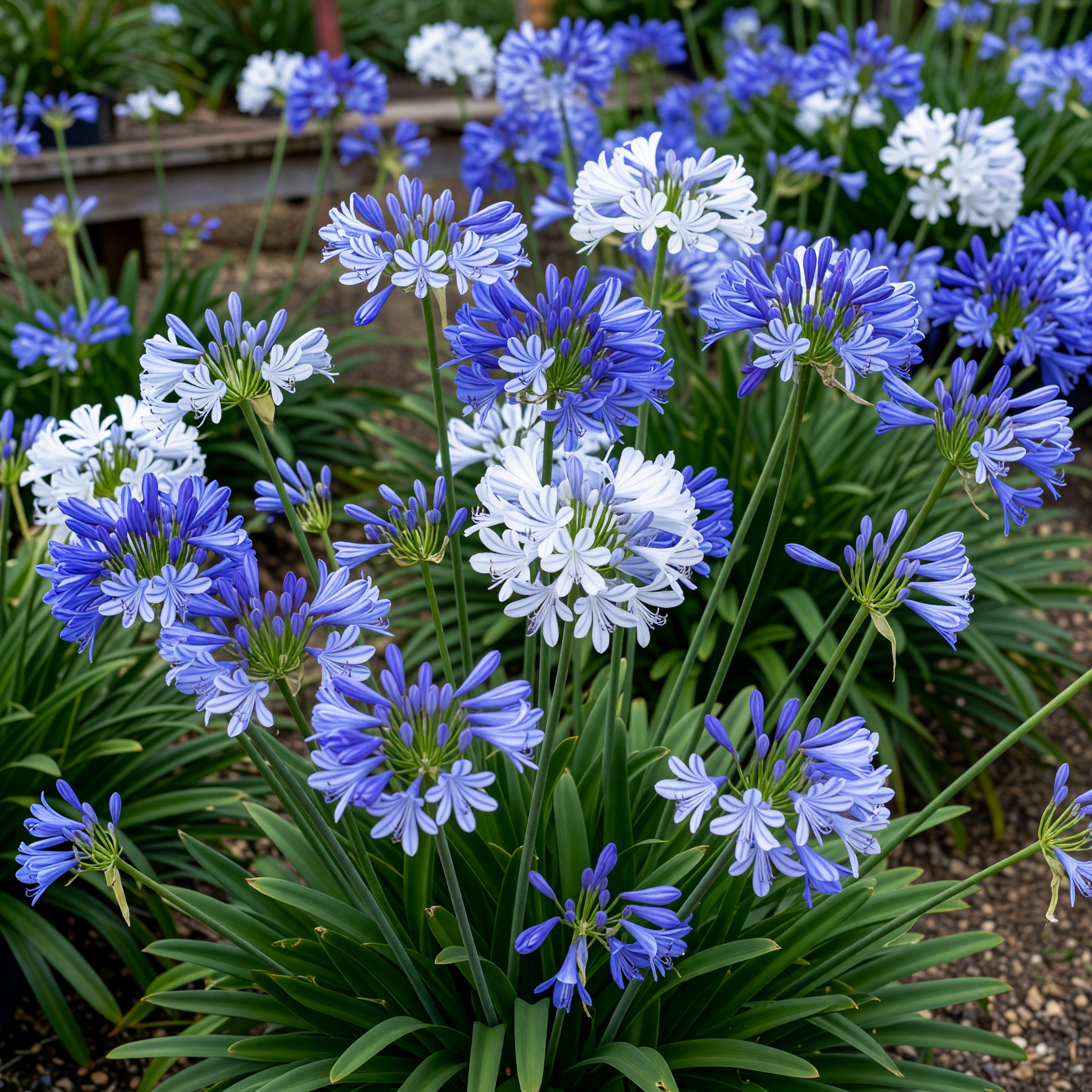
Agapanthus africanus ‘Twister’
A real showstopper, with striking globes of bicoloured flowers. Deep blue at the base, clean white at the tips. We find it works brilliantly in pots, or at the front of a sunny, well-drained border.
- Delivery from £45 in the region
- Free delivery on orders over £750
- In-house stock, high quality
Choose your desired size
Available
£13.95
Product information
We’ve had our eye on Agapanthus ‘Twister’ for a while. It’s a fantastic plant that brings a really distinctive look, with dense heads of trumpet-shaped flowers that are a rich blue in the throat, fading to pure white on the edges of the petals. The flowers appear from mid-summer on strong, upright stems above clumps of strap-like green leaves. It’s a reliable performer that bulks up nicely year after year.
This is a fairly compact variety, with the foliage forming a clump around 50cm high and the flower stems reaching up to 60-70cm. It’s a deciduous type, so the leaves will die back in winter. For the best results, give it a spot in full sun in well-drained soil. It doesn’t like to be waterlogged, especially over winter, so adding a bit of grit for drainage when planting is a good idea if you have heavy soil.
Once established, ‘Twister’ is reasonably drought-tolerant but appreciates a good water during the growing season. To keep things looking tidy, you can remove the flower stems once they’ve faded. We think it looks great planted in drifts in a gravel garden or in a large container on the patio, where it really makes a statement.
Product Details
Common NameAfrican Lily 'Twister'
Growth RateModerate
Max height0.7 M
Bloom TimeMid to late summer.
Flower ColourBicolour; deep blue at the throat fading to white at the petal tips.
Leaf ColourDark green.
SunlightFull sun.
PruningIn late autumn remove any remaining leaves, but seedheads can be left as they look attractive over winter. Deadhead spent blooms to prolong flowering.
Seasonal SpringFresh strap-like, green leaves emerge, forming a clump.
Seasonal SummerStrong, upright stems appear, topped with large, rounded heads of bicolour blue and white flowers from July to September.
Seasonal AutumnSeedheads can be left for architectural interest. The deciduous foliage will begin to die back.
Seasonal WinterThe plant is dormant. In colder areas, a dry mulch can be applied to protect the crown.
Fruit DescriptionAfter flowering, large green seed pods develop, maturing to a tan colour.

Need any help or advice?
We are happy to provide you with personal advice. We would love to see you in our store or contact us.
Call us
01832 293755Get help
Support pageYou may also like
from£3.85
Available
from£3.65
Available
from£3.50
Available
from£6.95
Available
from£10.95
Available
from£5.95
Available
from£7.95
Available
from£3.75
Available

from£14.95
Available
from£6.95
Available